By Harry Mills, Managing Director, Oku Markets · Updated
Inherent vs Residual FX Risk: Measuring Your Exposure
Measure business FX risk before and after hedging. Learn the difference between inherent and residual currency risk, with a practical cash-flow example.
3-minute read
Inherent risk and residual risk are simple but important concepts to grasp when assessing risk. This article explores how these concepts fit into a risk management programme and why it’s important to know your numbers!
Definitions
- Inherent risk – the amount of risk in the absence of controls
- Residual risk – the amount of risk after the application of controls
💡Inherent risk is before controls are applied, residual risk is after
- Risk control – a process, policy, or action designed to modify a risk
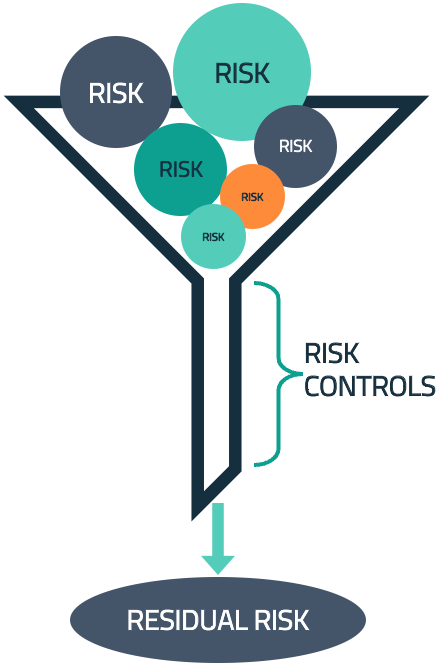
Assessing Risk
When assessing risk, it is important to use quantitative and qualitative methods. Running a collaborative Risk and Control Self Assessment(RCSA) workshop with relevant stakeholders allows the following questions to be answered:
- What are the inherent risks?
- What is the likelihood and potential impact of the risks?
- What control are in place and, how effective are they?
- What are the residual risks?
💡It is important to consider the level of risk the business is willing to take in order to achieve its strategic objectives!
Business Currency Risk
At Oku Markets, we utilise a carefully designed suite of currency risk measurements to calculate a business’ inherent risk and residual risk. In other words, we calculate the level of risk that a business is exposed to before and after implementing a hedging programme.
When designing a currency hedging strategy, it’s important to follow these steps:
- Outline the business’ objectives and risk appetite
- Consider the business’ sales, stock, and pricing cycles
- Understand the competitive environment in the business’ marketplace
- Identify and assess (measure) currency risks – inherent risk
- Qualitative assessment including “what if” questions
- Develop hedging strategies to fit around the business’ unique circumstances
- Back-test and forward-test to demonstrate effectiveness – residual risk
- Select the most appropriate strategy based on quantitative and qualitative tests
Need our help?
A worked FX exposure example
Suppose a UK business must pay €1 million in six months and has no euro receipts to offset it. Before hedging, the full €1 million payment is exposed to changes in the sterling/euro exchange rate: this is its inherent transaction exposure.
If it books a forward contract for €600,000, the remaining €400,000 still needs to be bought at a future rate. That is the residual unhedged transaction exposure. A 10% rise in the sterling cost of euros would increase the sterling cost of that unhedged portion by approximately 10%, assuming the payment forecast remains unchanged.
This simplified example measures exposure, not every aspect of risk. Forecast changes, contract obligations, credit and liquidity requirements also matter. Test those factors when comparing FX hedging programmes.
Our FX risk-management service helps measure exposure and test protection against your objectives. Discuss your currency risk with Oku Markets.
Implementing an effective currency risk strategy can be a daunting task and, there are many FX companies that aren’t up to that task! This is where we come in…
We’re proud to work transparently with our clients, and we work hard to break the asymmetry of knowledge and information in the FX market.
You can contact us for a review of your currency processes and for our guidance and suggestions at info@okumarkets.com or 0203 838 0250.
Thanks for reading 👋